
The third and final test in the series of landing experiment (LEX-03) was conducted at 07:10 1ST at the Aeronautical Test Range in Chitradurga, Karnataka.

Manish Malhotra's Diwali Party had the who's who of Bollywood in attendance.

'Sunny sir keeps me distracted from my morning sickness.'
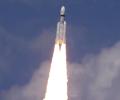
For the Gaganyaan programme, LVM3 rocket is re-configured to meet the human rating requirements and has been christened as 'Human Rated LVM3', ISRO said and it would be capable of launching the Orbital Module to an Low Earth Orbit of 400kms.

ISRO's maiden solar mission, Aditya L1, has captured its first high energy X-ray glimpse of solar flares. During its first observation period from approximately October 29, the High Energy L1 Orbiting X-ray Spectrometer (HEL1OS) on board Aditya-L1 spacecraft has recorded the impulsive phase of solar flares, the space agency said in a statement on Tuesday.
This year saw a lot of celebrities embracing parenthood, and they have given the Class of 2024 some unusual names.
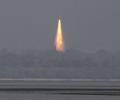
Indian Space agency Indian Space Research Organisation would launch the Geo-synchronous Satellite Launch Vehicle-Mark III (LVM3 X mission) on December 18 which would carry active solid boosters, liquid core stage and a passive cryo-stage.
'Govinda was a legend in his own right, with a style no one can copy.'

Directed by Raj and DK, and written by Sita R Menon, the spy series stars Varun Dhawan and Samantha, and is a prequel to Priyanka Chopra's Citadel. Citadel: Honey Bunny begins streaming from November 7 on Amazon Prime Video.

Staying fit during this season can be a task but Namrata Thakker compiles these celebrity images to give you all the #MondayMotivation you need to sweat it out and stay fit.


On Sunday morning, in its mission to place an earth observation satellite and students satellite into the low earth orbit, the SSLV-D1/EOS-02 blasted off precisely at 9.18 am amid cloudy skies from the first launch pad at Satish Dhawan Space Centre in this spaceport.

According to his family friends, Narasimha was in the league of the Missile Man of India and former president Dr A P J Abdul Kalam.

Here's a breakdown of how the series of events unfolded at the Satish Dhawan Space Centre at Sriharikota

Diamonds may be a girl's best friend. But what glitters forever is gold. Here are different ways Bollywood's beauties are glamming it up in 24 karat pieces.

Sukanya Verma picks 10 essential David Dhawan movies you need to watch to understand their loony appeal.

Shraddha gets Stree right... Katrina's Austrian diaries... Tiger is Xcited...

Varun's constant khubsoorati... Parineeti gets snapped in London... Malaika in magic light...

Friday's mission is the fourth operational flight of LVM3 which aims to launch the Chandrayaan-3 spacecraft into a Geo Transfer Orbit.

Indian Space Research Organisation (ISRO) will conduct three more test vehicle missions under the ambitious Gaganyaan programme after the maiden TV-D1 test flight, which is scheduled on October 21, the space agency's chairman S Somanath has said.

Preparations are in the final stages by the Chennai-headquartered space-tech startup Agnikul Cosmos for the maiden launch of India's first-ever private launchpad and the second rocket launch by a private sector player.

According to ISRO officials, the spacecraft will be placed in a halo orbit around Lagrange point 1 (L1) of the Sun-Earth system, about 1.5 million km from the Earth. The L1 point is about one per cent of the total distance between the Earth and the Sun.

EOS-01 is an earth observation satellite intended for applications in agriculture, forestry and disaster management support, ISRO has said.
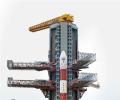
A 48-hour countdown began on Monday for the launch of record 20 satellites, including India's latest earth observation Cartosat-2 Series Satellite, onboard PSLV C-34 from Sriharikota on June 22.


Film folk have been celebrating #ArmyDay by posting pictures with the men in green on social media.

Shilpa in Wonderland... Kajol is optimistic... Dia is enjoying Sri Lanka...

Priyanka Chopra Jonas, Samantha and Matilda De Angelis got together to attend the London premiere and celebrate the upcoming releases of Citadel: Diana and Citadel: Honey Bunny.

The Indian Space Research Organisation (ISRO) will perform the final manoeuvre on Saturday to inject Aditya-L1 spacecraft -- the first space-based Indian observatory to study the Sun -- into its final destination orbit, some 1.5 million kilometres from the Earth.
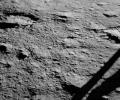
The lessons learned from the failure of Chandrayaan-2 contributed to the success of India's third lunar mission, former space scientist with the Indian Space Research Organisation (ISRO) Nambi Narayanan said, after the successful touchdown of the 'Vikram' lander on the lunar South Pole.

There's certainly a lot of love in the air, as Bollywood couples celebrate Christmas on social media.

John unveils his next movie... Nimrat on a movie she cherishes...Varun, Ranveer, Aditya watch some fighting...
In a landmark journey into a new era of space application, India successfully launched its first dedicated navigation satellite using the Polar Satellite Launch Vehicle, which blasted off from the Satish Dhawan Space Centre in Sriharikota, Andhra Pradesh.
India on Monday successfully launched five foreign satellites from four countries on board PSLV-C23 rocket which placed them in orbit, an achievement described by Prime Minister Narendra Modi as an 'endorsement' of the country's space capabilities.

Fresh from his exploits in Mumbai's maiden Syed Mushtaq Ali T20 triumph, Kotian got down to business after his pace colleagues Tushar Desphande (2/23) and Mohit Avasthi (1/29) handed Bengal early blows.
In a New Year gift to the nation, the Indian Space Research Organisation on Sunday successfully launched a Geosynchronous Satellite Launch Vehicle with an indigenous cryogenic engine from the spaceport of Satish Dhawan Space Centre in Sriharikota, entering a select club of nations.
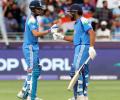
Since first opening the batting together in January 2023, the duo has been prolific in 50 overs cricket.
In an exclusive commercial launch to be witnessed by Prime Minister Narendra Modi, India's national space agency ISRO is set to launch five satellites from four countries from the spaceport of Sriharikota.

The mission objective is to ensure data continuity of ocean color and wind vector data to sustain the operational applications.
ISRO has put out stunning photos of the launch of GSLV-D5. The vehicle smoothly lifted off to space from Sriharikota on Sunday afternoon and put India into the elite 'cryogenic club'.
